 YUANNENGJI
 Use o bloco R×1K do multímetro, e conecte as pontas de teste vermelha e preta às duas pontas do diodo auto-piscante alternadamente. Quando uma das medidas é encontrada, a agulha primeiro balança para a direita por uma certa distância, e então a agulha começa a tremer (oscilar) ligeiramente nesta posição, com uma amplitude de cerca de uma pequena grade. Este fenômeno mostra que o circuito integrado dentro do diodo autopiscante começa a oscilar sob a ação da tensão da bateria de 1,5V dentro do multímetro, e a corrente de pulso de saída faz com que o ponteiro trema, mas o LED não pode emitir luz porque a tensão é muito baixa. Contudo, this phenomenon shows that the connection method of the red and black test leads of the multimeter is correct, isto é, the black test lead of the multimeter is connected to the positive pole of the self-flashing diode.Note: When judging the positive and negative poles of the self-flashing diode, do not think that the black test lead is connected to the positive pole of the diode in the measurement with a small resistance, as in the case of measuring ordinary diodes.
What about the positive and negative poles of the light-emitting diode? De facto, it is also very simple. For light-emitting diodes, the longer leg is positive and the shorter leg is negative. If the legs are the same length, the larger one in the light-emitting diode is the negative pole, and the smaller one is the positive pole. In the multimeter: the red test lead is connected to “+”, the black test lead is connected to “-“; when measuring the light-emitting diode, the low resistance range cannot be measured. You can use the RX10K range to measure. The two test leads touch the two poles of the diode. If the resistance is small, the black test lead is connected to the positive pole. If the resistance is large, the black test lead is connected to the negative pole. When the light-emitting diode is connected to the TTL component, a 470Ω voltage drop resistor is generally required to be connected in series to prevent damage to the device.
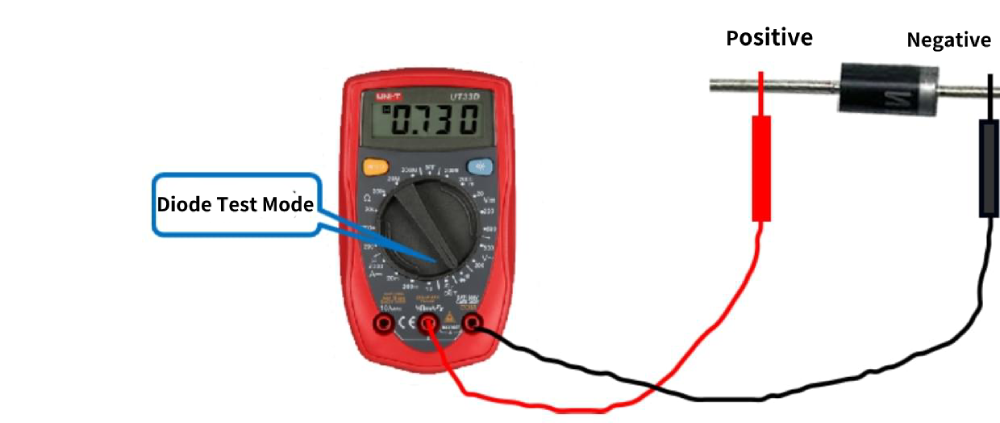
How to quickly distinguish the positive and negative poles of the light-emitting diode? De facto, it is also very simple. The long leg of the light-emitting diode is positive and the short leg is negative. If the legs are the same length, the larger one in the light-emitting diode is the negative pole, and the smaller one is the positive pole. In the multimeter: the red test lead is connected to “+”, the black test lead is connected to “-“; when measuring the light-emitting diode, the low resistance range cannot be measured. You can use the RX10K range to measure. The two test leads touch the two poles of the diode. If the resistance is small, the black test lead is connected to the positive pole. If the resistance is large, the black test lead is connected to the negative pole. Quando um diodo emissor de luz é usado em conexão com um componente TTL, geralmente é necessário conectar um resistor de queda de 470Ω em série para evitar danos ao dispositivo.
Método de uso de um multímetro para determinar os pólos positivo e negativo de um diodo auto-piscante:
Use o bloco R×1K do multímetro, e conecte as pontas de teste vermelha e preta às duas pontas do diodo auto-piscante alternadamente. Quando uma das medidas é encontrada, a agulha primeiro balança para a direita por uma certa distância, e então a agulha começa a tremer (vibrar) ligeiramente nesta posição, com uma amplitude de oscilação de cerca de uma pequena grade. Este fenômeno mostra que o circuito integrado dentro do diodo autopiscante começa a oscilar sob a ação da tensão da bateria de 1,5V dentro do multímetro, e a corrente de pulso de saída faz com que o ponteiro trema, mas a tensão é muito baixa para fazer o diodo emissor de luz emitir luz. Contudo, this phenomenon shows that the connection method of the red and black test leads of the multimeter is correct, isto é, a ponta de teste preta do multímetro está conectada ao pólo positivo do diodo auto-piscante.